Decarbonising
Industrial Heat
5.0
Processing, drying, baking, heating, distilling, pasteurising or producing steam: a large proportion of industrial processes require heat.
35+
Globally, heat accounts for 75% of industrial energy demand. Yet, unlike many other applications that can be electrified, a significant proportion of this heat – 70% – is still produced using fossil fuels.
$0.00
Decarbonising industry means addressing one of its most fundamental needs: producing large quantities of heat reliably, competitively and with low carbon emissions.Jimmy was founded to tackle this challenge.
What Solutions Are Available for Decarbonisation?
Industrial companies need to develop an energy mix tailored to their specific needs, combining different energy sources.
Today, few reliable, low-carbon solutions can provide a continuous supply of large quantities of heat at temperatures above 250°C.
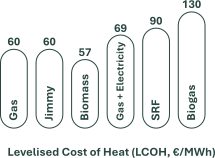
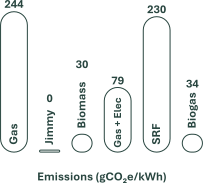
Nuclear energy, an area in which France has strategic advantages, is one of the solutions to the challenge of decarbonising industrial heat.
SMRs: A Competitive Advantage for European Industry
5.0
More compact, modular and standardised than conventional nuclear reactors, SMRs open up new applications for nuclear energy, particularly the direct production of industrial heat.
By being installed close to where heat is needed, they provide industrial companies with a low-carbon, controllable and continuously available energy supply, while reducing their dependence on fossil fuels.
5.0
With heat supply contracts spanning 20 to 30 years, SMRs provide industrial sites with long-term energy security, ensuring a competitive heat supply that is not exposed to the uncertainties associated with other energy sources, such as fluctuations in availability, price and quality.
Unlike a conventional nuclear power plant, Jimmy's generator does not produce electricity: it directly supplies the heat required for industrial processes.
Jimmy's generator is designed to meet industrial heat requirements:
Up to 470°C
To meet the needs of a wide range of industrial processes.
60 MWth
With the option of combining multiple generators to meet specific requirements.
Continuous Production
With a target availability rate of 90%.
Up to 100% fewer greenhouse gas emissions compared with natural gas.
By directly replacing fossil fuel-based heat production.

